
By Nabeel Ayub | Tekvix | Real Estate Systems Architect
Introduction
If you’ve built or managed a real estate website in the last decade, you’ve almost certainly dealt with IDX. It’s the backbone of most brokerage websites , the system that pulls MLS listings and displays them to buyers. For years, IDX was the only practical option available.
But something has shifted. Across the real estate technology landscape, brokerages, PropTech startups and real estate operators are increasingly asking a different question: why are we renting access to our own data?
The answer to that question is driving a fundamental transition , from passive IDX consumers to active data owners powered by the RESO Web API. This blog breaks down exactly what that shift means, why it matters, and what building a real estate platform looks like on the other side of it.
“The brokerages winning in 2026 are not the ones with the best IDX plugin. They’re the ones who own their data infrastructure and build intelligence on top of it.” Nabeel Ayub, Tekvix
What Is IDX and How Does It Actually Work?
IDX stands for Internet Data Exchange. Despite what many people assume, IDX is not a technology , it is a policy framework. It is a set of rules and agreements between brokerages and their MLS that governs how listing data can be displayed publicly on websites.
Under IDX, a brokerage receives permission to display other brokers’ listings on their own website. The actual data delivery happens through several technical methods:
| Method | How it Works | Key Limitations |
| Iframe | Embeds a third-party search widget directly into your site | Difficult Google to index framed content |
| FTP Transfer | Batch file transfer of listing data on a schedule | Slow, outdated, no real-time updates |
| RETS | Real Estate Transaction Standard older API protocol | Deprecated, complex, no standardization across MLSs |
| IDX Plugin/Vendor | Third-party SaaS pulls data and serves it on your behalf | Third Party data, No Control |
What Is RESO and the RESO Web API?
The RESO Web API is the modern, standardized protocol for accessing MLS data directly. Built on RESTful architecture using OData and JSON , the same standards that power modern web applications across every industry , it represents the evolution from legacy RETS connections to a developer-friendly, scalable data access layer.
What the RESO Data Dictionary Does?
One of the most underappreciated aspects of RESO is the Data Dictionary. This is a standardized set of field names, data types and lookup values that every certified MLS must adhere to. Without it, connecting to five different MLSs means dealing with five completely different field naming conventions.
With the RESO Data Dictionary, a property’s listing price is always ListPrice. The number of bedrooms is always BedroomsTotal. The listing status is always StandardStatus. This standardization is what makes building multi-MLS platforms at scale actually feasible.
RESO vs IDX: A Direct Comparison
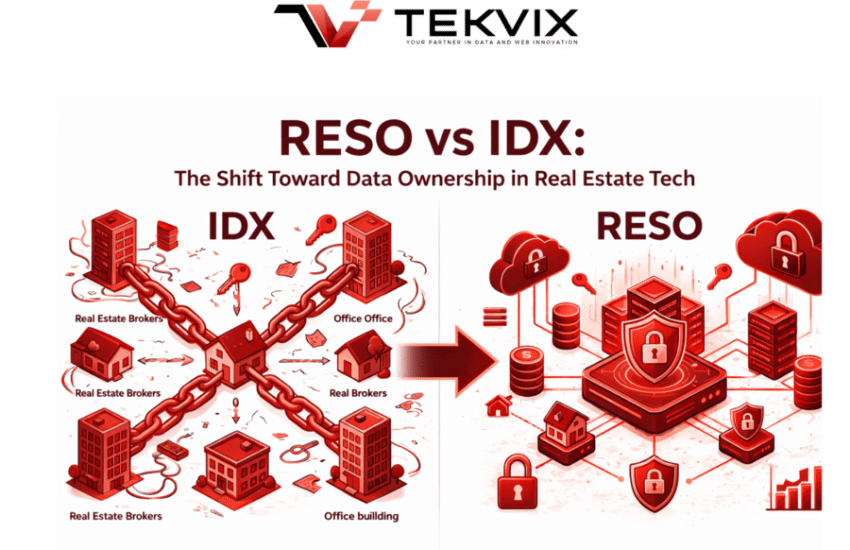
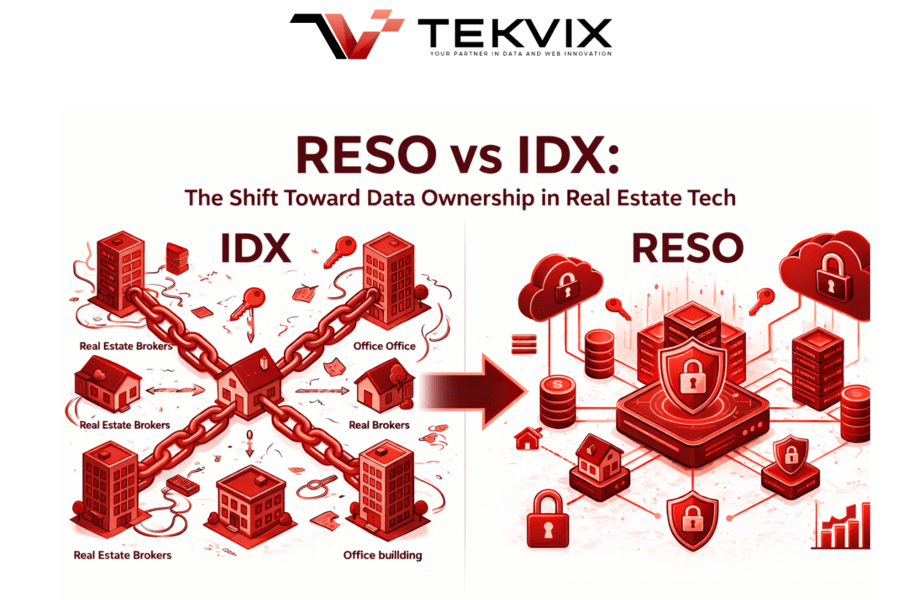
This is where most discussions go wrong treating RESO and IDX as competing alternatives when they actually operate at different layers of the real estate data stack. Understanding the distinction is critical for any builder or operator making infrastructure decisions.
| Dimension | Traditional IDX | Reso Web API |
| What it is | Policy framework + display rules | Technical standard + data protocol |
| Data ownership | Rented you display, not own | Owned you ingest and host |
| Data freshness | Delayed vendor-controlled sync | Real-time direct API queries |
| SEO value | Minimal often iFrame based | Full data on your own servers |
| Customization | Limited by vendor UI constraints | Unlimited — build anything on top |
| AI/analytics/automation | Not possible no raw data access | Full access build any layer on top |
| Multi-MLS support | Complex separate vendor per MLS | Standardized across all RESO-certified MLSs |
| Monthly cost | Subscriptions to vendor | Direct MLS access no middleman fee |
| Platform risk | High vendor controls your data | Low you own the infrastructure |
What Owning Your RESO Pipeline Actually Looks Like
This is the architecture shift that changes everything. Instead of pointing your website at a third-party IDX vendor and hoping their uptime holds, you build a direct connection to the MLS through the RESO Web API and replicate data into your own infrastructure.
The Replicate-and-Serve Architecture
The most common and scalable approach for serious real estate platforms is what engineers call replicate-and-serve. Rather than querying the MLS API on every user request (which creates latency and rate limit problems), you build an ingestion pipeline that keeps your own database continuously in sync with the MLS.
The RESO Pipeline Architecture
MLS / RESO Web API Endpoint
↓ Incremental delta queries (ModificationTimestamp)
Ingestion Layer (Python / n8n / custom worker)
↓ Field mapping to RESO Data Dictionary 2.0
Normalization & Transformation Layer
↓ Canonical data model across all MLS sources
Your Database (PostgreSQL / Elasticsearch / Redis)
↓ APIs, analytics, AI layers, search indexes
Your Website / Apps / Dashboards / AI Agents
Multi-MLS Support Without the Multi-Vendor Chaos
One of the biggest advantages of the RESO standard becomes clear when you need to support multiple MLS regions. With traditional IDX vendors, each MLS requires a separate vendor agreement, separate integration, separate monthly fee and separate data format to deal with.
With a RESO-based pipeline, the same ingestion architecture works across every RESO-certified MLS. At Tekvix we have built pipelines connecting Bright MLS, Stellar MLS, Northstar MLS using the same core infrastructure. The data dictionary standardization means the normalization layer handles the minor field variations automatically.
Why Data Ownership Unlocks AI Capabilities
This is the part that most brokerages and PropTech founders do not see until they have made the shift. Owning your RESO pipeline does not just reduce costs and eliminate vendor dependency. It fundamentally changes what you can build on top of your property data.
What Becomes Possible With Raw MLS Data Access
- Stale listing detection: Automatically flag listings where engagement drops below benchmarks and alert agents before a property loses market momentum.
- AI deal scoring: Feed property attributes, market velocity data and comparable sales into a scoring model that ranks acquisition opportunities in real time.
- Buyer matching at scale: When a new listing hits your pipeline, instantly match it against your entire buyer database and trigger personalized alerts , something no IDX vendor can do.
- Predictive pricing: Build ARV models, rental yield calculators and investment return projections directly on your normalized RESO data.
- Natural language search: Use vector embeddings on property descriptions to enable semantic search , buyers finding homes by feeling, not just filtering by bedrooms.
- Agent performance analytics: Cross-reference listing data with CRM activity to measure which agents convert which types of listings fastest and in which neighborhoods.
- App: Build full stack custom web/mobile app on your MLS data.
Common Objections And the Reality
When brokerages and operators consider moving to a RESO pipeline, the same concerns come up. Here is an honest assessment of each.
“It’s too complex to build and maintain”
Building your first RESO integration is genuinely non-trivial. You need to understand OData query syntax, handle pagination correctly, manage delta syncing, deal with rate limits and build a normalization layer. But this is a solved problem for experienced real estate systems architects. The complexity is a one-time investment, not a recurring burden.
“We don’t have the in-house engineering for it”
Most brokerages don’t and don’t need to. A well-architected RESO pipeline, once built, runs autonomously with minimal maintenance. The engineering is front-loaded. Ongoing maintenance is closer to DevOps monitoring than active development.
“Our IDX vendor handles compliance for us”
This is true and it is also the dependency. When your vendor handles compliance, they also control your data, your features and your roadmap. Moving to a direct RESO connection means taking on compliance responsibility but it also means gaining the freedom to build whatever your business actually needs.
“The upfront cost is too high”
For a brokerage currently paying to an IDX vendor, a RESO pipeline investment pays for itself within the first year. The recurring savings alone justify the build cost, before accounting for the AI and analytics capabilities that become available each of which has direct revenue potential.
Who Should Be Making This Shift Right Now
Not every real estate operation needs to build a RESO pipeline today. Here is an honest breakdown of who should be moving now versus who can wait.
| Operator Type | Current Situation | Recommendation |
| Brokerage 10+ agents | Paying heavy subscription to IDX vendor | Move to RESO pipeline now |
| PropTech founder | Building MLS-dependent SaaS product | Build on RESO from day one |
| Acquisitions team | Manual comp pulling and analysis | RESO pipeline + AI scoring layer |
| Small team 1-5 agents | Basic IDX plugin on website | IDX vendor still practical for now |
| Multi-market operator | Multiple IDX vendor contracts | Consolidate to single RESO infrastructure |
The Tekvix Approach to RESO Pipeline Architecture
At Tekvix, we have built RESO data pipelines for real estate brokerages, acquisition teams and PropTech startups across the United States. Every pipeline we architect follows the same core principles:
- Data Dictionary compliance from day one: We build to the current RESO standard, not the legacy.
- Incremental syncing with full audit trail: Delta queries on ModificationTimestamp with logged sync history so you always know the state of your data.
- Canonical normalization layer: A unified data model that abstracts away MLS-specific field variations the same query works across Bright, CRMLS, Stellar, FMLS, Northstar and MRED.
- API-first architecture: Your RESO data is exposed through a clean internal API that powers every downstream surface website, mobile app, CRM, AI agents.
- Monitoring and alerting: Automated alerts when sync jobs fail, when data freshness drops below threshold or when MLS endpoints change behavior.
Conclusion: The Shift Has Already Started
The real estate industry is in the middle of a quiet infrastructure revolution. The brokerages and platforms that recognize it early will have a compounding advantage lower data costs, faster feature development and AI capabilities their competitors cannot replicate because they are still renting access to their own data.
RESO is not a replacement for IDX. It is the evolution of it putting control back in the hands of the operators who generate the data in the first place.

Founder of Tekvix, brings 6 years of industry experience in web development with expertise in Python and JavaScript. He has contributed to diverse ML and web projects and now focuses on advancing AI solutions through Large Language Models (LLMs) and LangChains..